Cyrus the Great and the end of the Babylonian exile, 539 BC
The relationship begins at the foundation of the Persian Empire itself. When Cyrus the Great conquered Babylon in 539 BC, he found the Jews of Judah living there in forced exile, deported after the Babylonian destruction of Jerusalem and its Temple. Cyrus did what no conqueror of his age was known to do: he let them go home. The biblical Book of Ezra records his decree permitting the Jews to return to Jerusalem and rebuild the Temple, and returning the sacred vessels the Babylonians had seized. The Book of Isaiah calls Cyrus the Lord's "anointed" — the only non-Jewish ruler in the Hebrew Bible given that title.
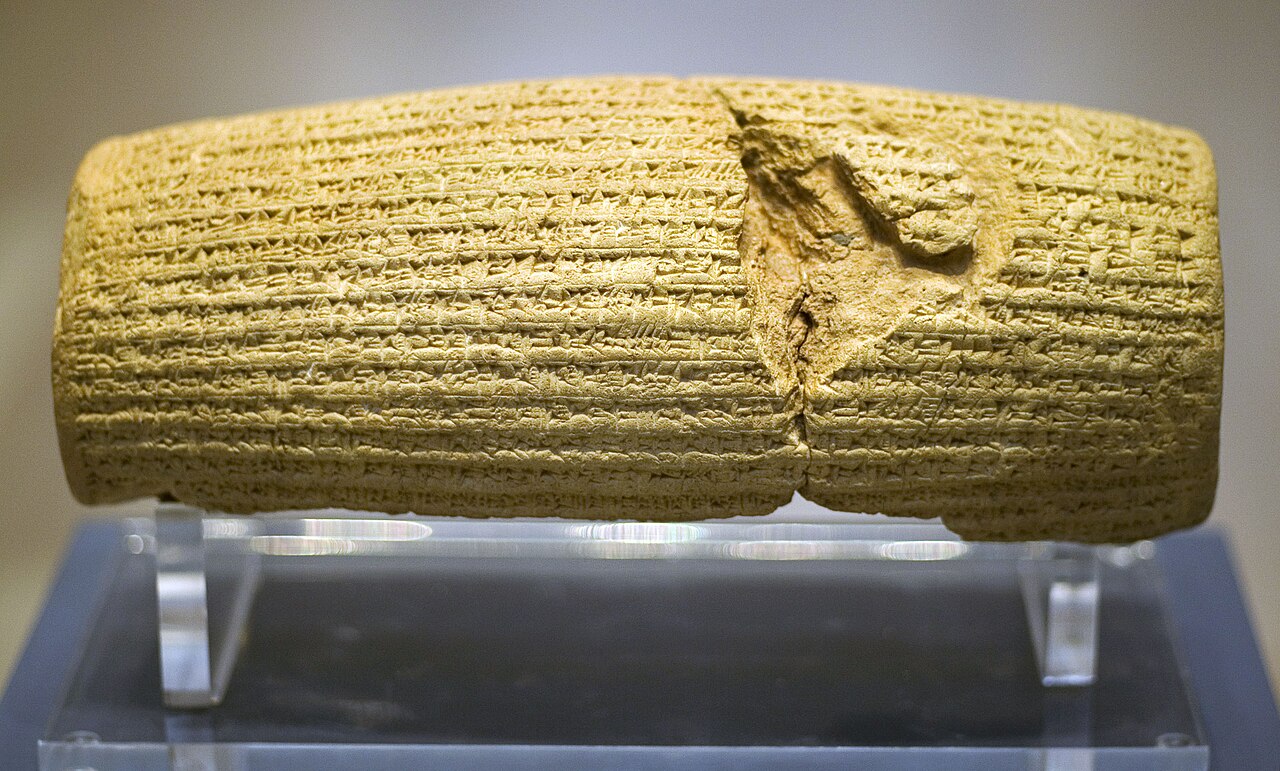
The Cyrus Cylinder, a clay inscription in the British Museum often called an early charter of humane rule, records the same policy for the peoples of Babylon generally: deported populations returned, sanctuaries restored. For Jews this was not an abstraction. A people that had been marched into captivity was restored by a Persian king, and Jewish tradition has remembered Persia as a place of rescue ever since.
Esther and Mordechai: the first recorded plot to annihilate the Jews — defeated in Persia
The Book of Esther is set in the Persian capital of Susa under King Ahasuerus, usually identified with Xerxes I. When the royal minister Haman persuades the king to authorize the extermination of every Jew in the empire — the first such genocidal decree recorded in history — it is a Jewish woman at the Persian court, Queen Esther, and her kinsman Mordechai who expose the plot and turn the king against it. The deliverance is celebrated to this day as Purim, and the Scroll of Esther is read in synagogues every year.
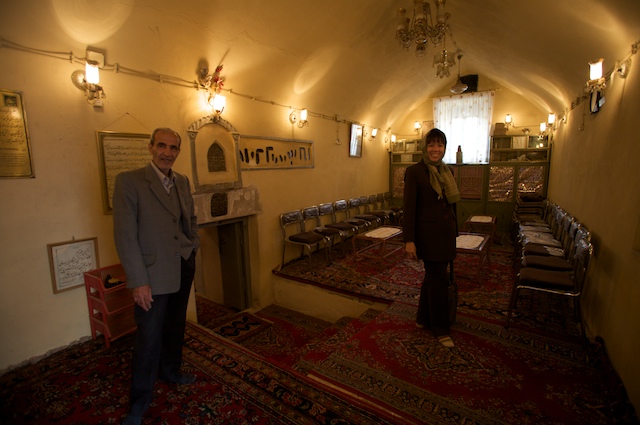
The story left a physical trace in Iran. The tombs traditionally ascribed to Esther and Mordechai stand in the city of Hamadan, in a shrine that remained a place of Jewish pilgrimage under Muslim rulers for more than a thousand years and is still visited today. Few countries on earth hold a Jewish holy site that old, still standing.
The Babylonian Talmud under Persian rule
Under the Parthian and then the Sasanian Persian empires, the Jewish communities of Mesopotamia — then Persian territory — grew into the intellectual centre of the Jewish world. Between the third and sixth centuries CE, rabbis in the academies of Sura, Pumbedita and Nehardea composed the Babylonian Talmud, the foundational text of Jewish law. It was written under Persian sovereignty, in a Persian-speaking world, during long periods of stability granted by Persian kings such as Shapur I, whom the Talmud itself remembers warmly. Judaism as it exists today was shaped, in large part, on Persian soil.
Jewish settlement on the plateau itself was ancient and deep. Isfahan's old Jewish quarter, Yahudiya, by tradition predates Islam; Jewish communities lived in Hamadan, Shiraz, Kashan, Yazd and dozens of smaller towns, speaking Persian and Judeo-Persian — Persian written in Hebrew script — and producing poets such as Shahin of Shiraz, who retold the Torah in classical Persian verse in the fourteenth century.
Under Islam: protection, hierarchy, and hard centuries
Honesty about this history requires saying the whole of it. After the Muslim conquest of Persia in the seventh century, Jews became dhimmis — a protected but subordinate class who paid a special tax and lived under legal disabilities. Conditions rose and fell with dynasties. The Safavid period (1501–1736) brought genuine persecution at times, including forced conversions under Shah Abbas II, alongside long stretches in which Jewish merchants, physicians and silk traders prospered. Under the Qajars in the nineteenth century, conditions were often harsh — European travellers described Jews in many cities as among the most oppressed communities of the empire — and Iranian Jews were among the first communities the Paris-based Alliance Israélite Universelle built modern schools for, from 1898 onward, precisely to lift them out of it.
Two things remain true across those centuries. No Iranian state, however discriminatory, ever attempted the physical extermination of its Jews. And the community never disappeared: Jews prayed, traded, taught and buried their dead in Persian cities for more than a thousand unbroken years — a continuity matched by very few diasporas anywhere.
Equal citizens: the Pahlavi decades, 1925–1979
Reza Shah's modernization brought Iranian Jews legal equality for the first time: the old restrictions on dress, residence and profession were abolished, Jews entered universities, the civil service and parliament, and the community flourished. By the 1970s Iran was home to between 80,000 and 100,000 Jews — the largest Jewish community in the Muslim world after Turkey — with synagogues, schools, hospitals and newspapers, concentrated in Tehran, Shiraz, Isfahan and Hamadan.
Iran also recognized the new State of Israel de facto in March 1950, the second Muslim-majority state to do so. For three decades the two countries maintained quiet but extensive ties — trade, an Israeli diplomatic mission in Tehran, El Al flights, oil shipments, and agricultural and intelligence cooperation. Iranian Jews travelled freely to Israel and back. To Iranians of that generation, friendship between the two peoples was not exotic; it was normal life.
Iranians and the Holocaust
When the Nazis invaded the Soviet Union in 1941, tens of thousands of Polish refugees — soldiers and civilians, among them several thousand Polish Jews — were evacuated east and reached Iran in 1942, where Tehran's Polish exile camp gave them shelter. Among them were roughly a thousand Jewish children, remembered as the "Tehran Children," orphaned or separated from their parents, whom Iran received and who were then taken on to safety in British Mandate Palestine. Yad Vashem preserves their testimony. Iran, an occupied and hungry country at the time, took them in.
In Nazi-occupied Paris, an Iranian diplomat named Abdol Hossein Sardari ran Iran's consular section after the legation withdrew. Facing the deportation of Iranian and other Jews, Sardari argued to the German authorities that Iranian Jews — "Djuguten" — were of Aryan Persian stock and not covered by Germany's race laws, and he issued Iranian passports and protection papers to as many Jews as he could reach, including non-Iranians. Historians estimate the documents he issued saved the lives of hundreds, possibly thousands, of Jewish families. He did it without Tehran's authorization, spent his own money on the effort, and died in obscurity in 1981. He is often called the "Schindler of Iran," and the United States Holocaust Memorial Museum and Yad Vashem have both documented his case.
1948 and after: refuge on the road to Israel
The creation of Israel triggered violent persecution of the ancient Jewish communities of the Arab world — the 1941 Farhud pogrom in Baghdad had already shown what was coming. As Jews fled Iraq, Syria, Yemen and elsewhere, many of them escaped across the Iranian border and found temporary safety in Iran on their way to Israel; the Iranian authorities of the time permitted and facilitated the transit, and Iranian Jews helped house and feed the refugees passing through. Iraq's Jews in particular crossed through Iran in large numbers in the late 1940s and early 1950s before the great airlift to Israel. At a moment when Jews were being stripped of citizenship and driven from countries where they had lived since before Islam, Iran was the place on the map that took them in rather than drove them out.
After 1979: the regime's ideology is not the people's history
The Islamic Revolution broke this record, but did not end the community. Ayatollah Khomeini made hostility to Israel and antisemitic conspiracy theory pillars of the new state's ideology; Jews emigrated in large numbers, and today between roughly 8,500 and 20,000 remain — still the largest Jewish community in the Muslim Middle East outside Israel, with a reserved seat in parliament, working synagogues in Tehran, Shiraz and Isfahan, kosher butchers and Jewish schools, living under discriminatory laws but insisting on remaining Iranian. Iranian Jews have repeatedly and publicly distinguished themselves from the regime's anti-Israel posture while affirming their Iranian identity.
The distinction matters for everything on this site. Holocaust denial conferences, "death to Israel" slogans and proxy wars are the policy of a theocracy that also shoots Iranian schoolgirls in the street. The Iranian people's own 2,700-year record with the Jews — Cyrus, Esther, the Talmud's academies, the Tehran Children, Sardari's passports, the refugee crossings of 1948 — is something else entirely: one of history's longest stories of one people sheltering another.
A shared culture that survived
The relationship left a common culture. Judeo-Persian literature spans a thousand years, from the earliest surviving New Persian documents — which are written in Hebrew letters — to Shahin's biblical epics. Persian-Jewish kitchens share ghondi, haleem and sabzi; Persian classical music counts Jewish masters among its great twentieth-century performers, and Jews were central to building Iran's modern recording industry. Today the largest communities of Iranian Jews outside Iran — in Israel, and in Los Angeles, the "Tehrangeles" of the diaspora — speak Persian, cook Persian, publish Persian newspapers and keep Nowruz. The culture crossed every border the regimes drew.
The long record, era by era
| Era | What happened | What it meant for Jews |
|---|---|---|
| 539 BC | Cyrus the Great takes Babylon and frees the Jewish exiles (Ezra 1; Isaiah 45). | Return to Jerusalem; the Second Temple rebuilt under Persian protection. |
| c. 480 BC | Events of the Book of Esther at the court of Susa. | Haman's extermination decree overturned; Purim established; Esther's tomb in Hamadan. |
| 3rd–6th c. CE | Babylonian Talmud composed in the academies of Sasanian Persia. | Jewish law codified under Persian rule; Persia the centre of Jewish learning. |
| 7th–17th c. | Muslim conquest; dhimmi status; Mongol and Safavid eras. | Protection with discrimination; periods of forced conversion, long periods of communal life. |
| 1898 | Alliance Israélite Universelle opens schools in Tehran and beyond. | Modern education spreads through the community. |
| 1925–1979 | Pahlavi modernization; legal equality; de facto relations with Israel from 1950. | The community grows to 80,000–100,000 and prospers. |
| 1942 | Polish Jewish refugees, including the "Tehran Children," reach Iran. | Asylum and transit to Palestine for Holocaust refugees. |
| 1942–44 | Consul Abdol Hossein Sardari issues Iranian passports to Jews in occupied Paris. | Hundreds, possibly thousands, of Jews saved from deportation. |
| 1948–52 | Jews fleeing Iraq and other Arab states cross into Iran en route to Israel. | Iran serves as a refuge corridor during the exodus from the Arab world. |
| 1979–today | Islamic Republic adopts antisemitic state ideology; most Jews emigrate. | A community of 8,500–20,000 remains — the largest in the Muslim Middle East — with a parliamentary seat. |
Sources
- Encyclopaedia Iranica — entries on "Judeo-Persian communities," "Esther and Mordechai," "Cyrus" and "Iranian Jews" (iranicaonline.org)
- United States Holocaust Memorial Museum — documentation on Abdol Hossein Sardari (ushmm.org)
- Yad Vashem — the Tehran Children archive and testimonies (yadvashem.org)
- The Hebrew Bible — Book of Ezra, Book of Isaiah, Book of Esther
- Encyclopaedia Judaica and the Jewish Virtual Library — "Iran" and "Persia" entries
- Alliance Israélite Universelle archives — schools in Iran from 1898
Why this page exists on a site about the Islamic Republic's crimes
Because the regime's propaganda insists that hostility to Jews is ancient, Persian and inevitable. It is none of those things. Antisemitism as state doctrine arrived in Iran in 1979, imported and imposed by the same men who imprison, torture and hang Iranians. The record above is the record of the Iranian people — and it is the strongest possible answer to the lie that Iran and the Jews are eternal enemies. Read more about the civilization the Islamic Republic is destroying.