Iran Holocaust

Why is Iran protesting?

The causes behind the current uprising, what makes it different from earlier protest waves, and how the state has responded.

Explainer · Crimson Winter · Dec 2025 – 2026

Short answer. Iranians are protesting because four decades of grievances converged: compulsory hijab and policing of women's bodies, mass executions, an economy in collapse, and unmet basics like water and electricity. The current wave began in late December 2025 and spread to more than 200 cities, met with live fire, mass arrests and internet shutdowns.

What are people protesting about?

  • Compulsory hijab and the policing of women. The Guidance Patrol, the surveillance of women in cars and workplaces, and the death of Mahsa Amini in 2022 remain the emblem of state control over private life.
  • Executions. Iran executes more people than any other country except China, including protesters convicted after summary trials. See executions.
  • Economic collapse. Currency depreciation, inflation and unpaid wages have pushed large parts of the salaried middle class into poverty.
  • Infrastructure failure. Rolling blackouts, gas shortages in winter and severe water scarcity have driven protests in provincial cities that had stayed quiet in earlier waves.
  • No route to change. Vetted elections, jailed lawyers and closed newspapers leave the street as the only remaining channel.

When did the current protests start?

The Crimson Winter uprising began in late December 2025 and escalated sharply in January 2026. The nights of 8 and 9 January 2026 produced the highest single-night death tolls, with Rasht the worst affected city.

How is this different from 2009, 2019 and 2022?

WaveTriggerCore demand
2009 Green MovementDisputed presidential electionReform within the system
2019 AbanPetrol price riseEconomic relief; then regime change
2022 Woman, Life, FreedomDeath of Mahsa AminiEnd of compulsory hijab and clerical rule
2025–2026 Crimson WinterCumulative: prices, blackouts, executionsEnd of the Islamic Republic

The current wave is broader geographically, more working-class, and no longer asks for reform. Slogans target the Supreme Leader directly.

How has the state responded?

With live ammunition, shotgun pellets fired at faces, mass detention, and national internet shutdowns timed to the worst nights. Documented totals and the range of independent estimates are on the death toll page; named victims are recorded in In Memoriam.

What can people outside Iran do?

Name victims publicly, press governments on designations and detainee cases, support verified reporting, and keep the record accessible when Iranians themselves are cut off. Concrete steps are listed on Act and in the current campaigns.

Frequently asked questions

Why are Iranians protesting in 2026?

Because of compulsory hijab enforcement, mass executions, economic collapse, blackouts and water shortages, and the absence of any lawful route to political change.

When did the 2026 protests in Iran begin?

The current wave began in late December 2025 and spread to more than 200 cities during January 2026.

What are the protesters demanding?

Unlike 2009, most slogans now demand the end of the Islamic Republic rather than reform of it.

How many people have been killed?

By late February 2026, monitors had verified 7,007 named deaths and over 40,000 detained; the true figures are likely higher because of internet shutdowns.

What does Woman, Life, Freedom mean?

Zan, Zendegi, Azadi — a slogan of Kurdish origin adopted nationwide in 2022 that frames women's freedom as the condition of everyone's freedom.

Is the internet shut down in Iran?

Iran has repeatedly imposed national and regional shutdowns, typically hours before the heaviest crackdowns, which delays and suppresses casualty reporting.

The causes in depth

Key facts

  • The Crimson Winter wave began in late December 2025 and reached more than 200 cities in January 2026.
  • HRANA's verified named list stood at 7,007 deaths when it closed on 23 February 2026, with thousands more cases still under review.
  • Iran Human Rights recorded at least 972 executions in 2024 and more than 1,500 in 2025.
  • The rial has lost the large majority of its value since 2018, and official inflation has stayed above 30 per cent in most years since.
  • Every national protest wave since 2017 has been met with internet shutdowns, live fire and mass arrests.

Why does the economy drive people onto the streets?

For most Iranian families the uprising began at the checkout. Since the United States reimposed sanctions in 2018, the rial has repeatedly hit record lows, and Iran's own Statistical Centre has reported annual inflation above 30 per cent in most years since. Food prices have risen faster still. Teachers, nurses, retirees and oil-sector contract workers held repeated strikes over unpaid or eroded wages long before the street protests began.

Protesters do not blame sanctions alone. A large share of the economy is controlled by bodies answerable to the Supreme Leader rather than to parliament, including foundations (bonyads) and companies linked to the Revolutionary Guard. Money spent on regional allies and missile programmes, while wages and pensions fall, is a recurring theme in slogans. The cost of that spending abroad is documented on beyond Iran.

How did water and power shortages fuel the protests?

Decades of dam building, over-pumping of groundwater and drought have left reservoirs serving Tehran, Isfahan and Mashhad at historic lows. In summer 2021, water protests in Khuzestan were met with live fire. In 2024 and 2025 rolling blackouts closed offices and factories, and winter gas shortages left homes cold. Officials openly warned that parts of the capital could run dry. For people in provincial cities, failing basic services became daily proof that the state could neither govern nor be held to account.

Why are women at the centre of the protests?

Compulsory hijab has been enforced since the early 1980s. Under Article 638 of the Islamic Penal Code, appearing in public without it is punishable by prison or a fine, and since 2024 the Noor Plan has used cameras, car seizures and business closures to enforce it. The 2022 death of Mahsa (Jina) Amini in the custody of the Guidance Patrol turned a dress code into a symbol of the state's control over every private life. That is why "Woman, Life, Freedom" became the shared slogan of people who are not otherwise political. The legal detail is on hijab law.

Why are Kurdish and Baluch regions hit hardest?

Kurdistan and Sistan-Baluchestan have long faced the heaviest repression. On 30 September 2022, security forces opened fire on worshippers and protesters in Zahedan; Amnesty International documented at least 66 people killed that day, in what became known as "Bloody Friday". Kurdish and Baluch prisoners are also heavily over-represented among those executed. Protests in these regions mix national demands with grievances over language rights, poverty and discrimination.

How did the protest waves build on each other?

Hundreds of thousands march past the Azadi Tower in Tehran during the Green Movement silent march of June 2009.
Tehran, June 2009. The Green Movement protested a disputed election and still sought reform within the system.
Major protest waves in Iran since 2009
YearTriggerOutcome
2009Disputed presidential election of 12 JuneLeaders placed under house arrest; dozens killed, thousands detained
2017–2018Prices and corruption, starting in MashhadProtests spread to provincial towns; slogans turned against the whole system
2019Overnight petrol price rise in NovemberNear-total internet shutdown; Amnesty confirmed at least 304 killed, Reuters reported about 1,500
2022Death of Mahsa AminiAt least 551 protesters killed and more than 22,000 arrested; protesters executed
2025–2026Prices, blackouts and executions combinedThe deadliest crackdown in the Islamic Republic's history
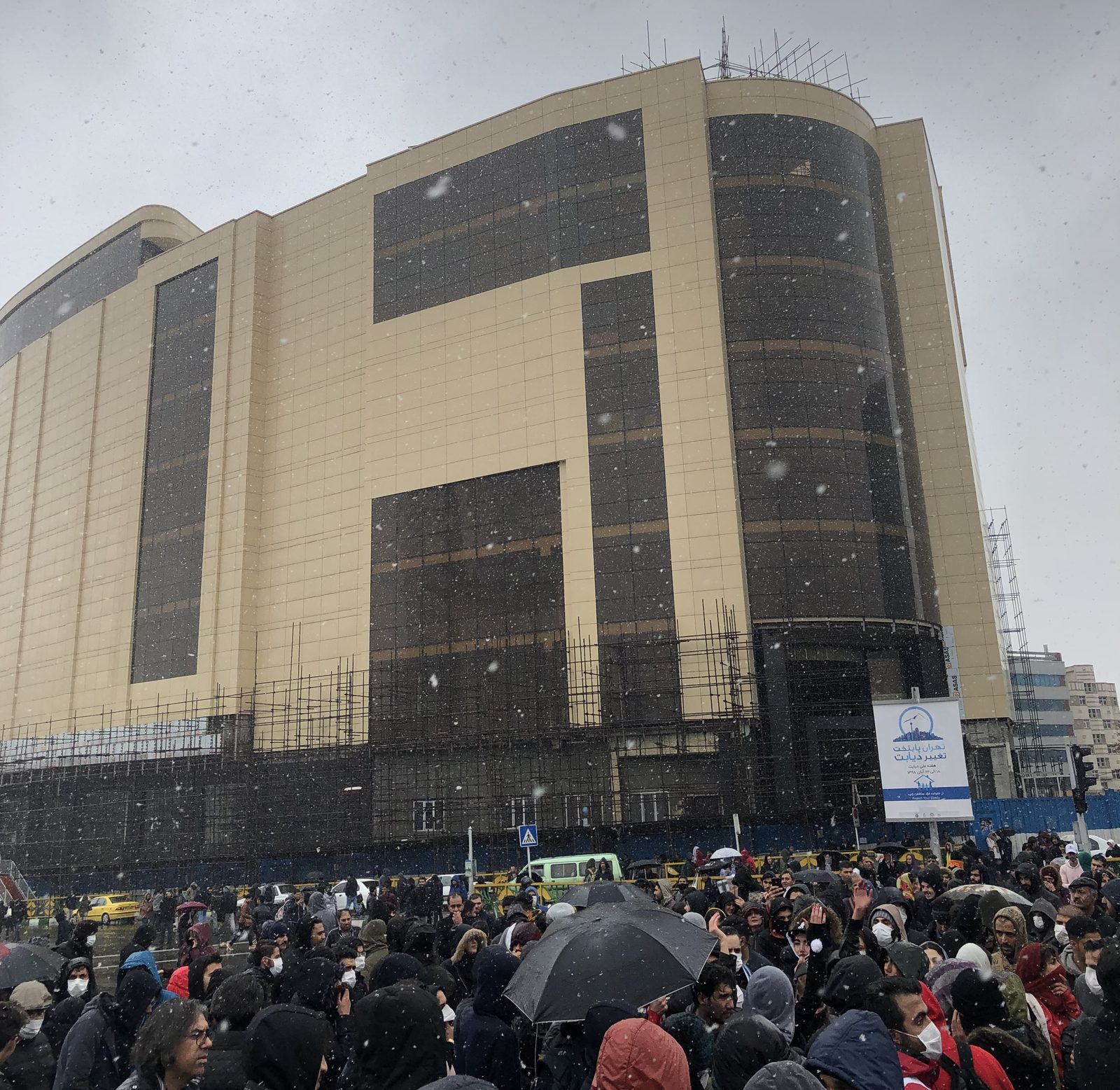
A dense crowd gathers in a Tehran street in front of a large building during the November 2019 protests.
November 2019. After a sudden petrol price rise, protests reached more than 100 cities before an internet shutdown hid the killings.

Each wave was crushed, and each left behind more people with nothing left to lose: families of the dead, released prisoners, and young people who had watched reform fail. That accumulated memory explains why the 2025–2026 slogans skipped reform entirely.

What role do young Iranians play?

A large share of Iran's population is under 35, highly educated and connected to the outside world through satellite television and VPNs. Graduate unemployment is high, and emigration among doctors, engineers and students has surged. Many of those killed in 2022 and 2026 were teenagers and students. Their funerals, often held under heavy security, became fresh protests in their own right.

What happened when the state cracked down in 2026?

Security forces used rifles, shotguns and machine guns against crowds, especially during the two nights of 8 and 9 January 2026, after the internet had been cut. Hospitals were placed under security control and families were pressed to bury their dead quickly or record deaths as accidents. Detainees have been charged with moharebeh ("waging war against God"), which carries the death penalty. The documented figures, and why estimates differ, are on the death toll page.

Sources

Human Rights Activists News Agency (HRANA); Iran Human Rights (IHR); Amnesty International reports on November 2019 and on Zahedan, 30 September 2022; UN Independent International Fact-Finding Mission on Iran; Statistical Centre of Iran inflation releases; Reuters reporting on November 2019. Full source notes are on the methodology page.

How to understand overlapping demands without oversimplifying them

Shared protest does not require identical motives

Economic insecurity, restrictions on women's lives, executions and distrust of institutions can overlap in a movement. That does not mean every participant gives them the same priority. A national slogan records an expression heard at particular gatherings, not the results of a representative survey of every Iranian.

The strongest accounts connect a stated grievance with the people, place and date where it was reported. They distinguish what participants said from an observer's interpretation. This preserves the movement's variety while still explaining why people with different immediate concerns may recognise the same problem of accountability.

Read the December economic and political context

Women’s refusal links a daily rule to a larger question

Girl of Enghelab Street
Girl of Enghelab Street, from the credited Wikimedia Commons photograph by Elph. Historical context for resistance to compulsory veiling, not a 2026 protest image. Elph · CC BY-SA 4.0 · Wikimedia Commons

Compulsory hijab is experienced through ordinary activities: travelling, studying, working and using public services. The hijab-law account explains the distinction between the statutory framework and reported enforcement practices. The Mahsa Amini account explains why a death in custody became central to the 2022 uprising.

Public acts of refusal also have their own histories. The accompanying Girl of Enghelab Street image belongs to that history and is not presented as a January 2026 photograph. Its relevance is the visible challenge to compulsory veiling. A photograph can document such an act without establishing the motives of all women who later participated in protest.

Follow the law and its enforcement

Read Mahsa Amini’s story

Regional experience should remain specific

Kurdish and Baluch communities recur in the archive, but are not interchangeable populations. A local incident, a language-rights grievance and an execution record each concern different questions. Their sources and geographical scope should remain visible rather than being converted into a single undifferentiated regional narrative.

The same care applies to comparisons between a capital and provincial towns. Establishing that one city protested does not establish the movement's national social composition. City-level records and individual biographies are more useful than sweeping claims about who protested first or which group represented the whole uprising.

Read named records from different places

What comparing protest waves can show

The timeline places the disputed 2009 election, the 2019 fuel-price protests and the 2022 uprising in sequence. Each had a particular immediate setting, and each left evidence that should be read in its own reporting period. Comparisons can identify recurring methods of repression without assuming that the outcomes or casualty categories are directly comparable.

The 2025–2026 record should likewise distinguish an economic trigger, reported slogans and the subsequent state response. A cause of protest is not a justification for lethal force, and a description of repression is not a survey of political preferences. Keeping those questions separate helps readers understand the history without claiming more than the sources establish.

Compare earlier protest waves

Compare casualty records and their scope

All questions about Iran, answered

Every sourced question and answer on this archive, gathered on one page. Short answers first, with a link to the full page behind each one.

Mahsa Amini, hijab law and Woman Life Freedom →

Open the full FAQ hub →